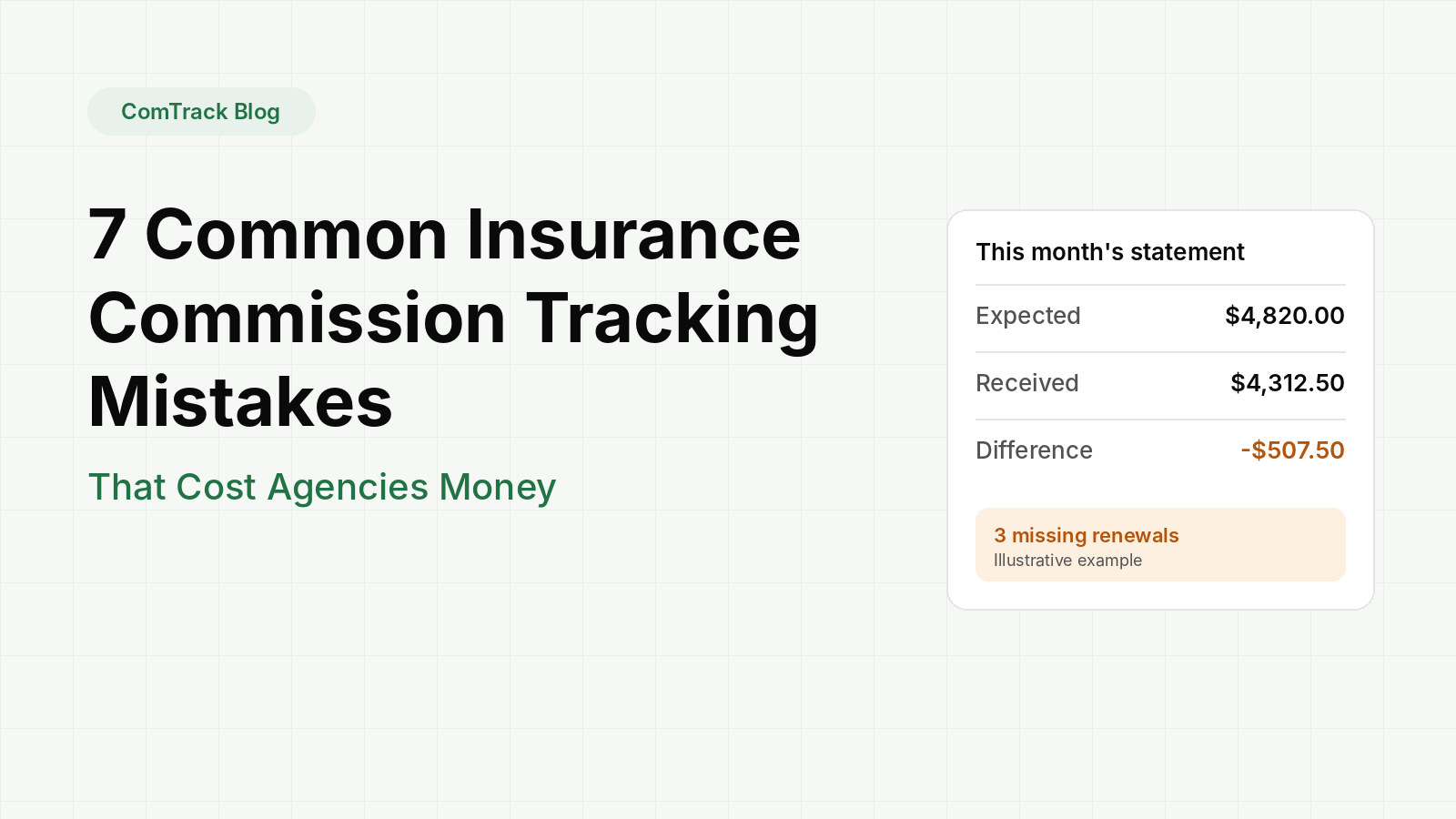
Tracking commissions is one of the most critical operational tasks for an independent insurance agency, yet it is often the most neglected. For independent agents and agency owners, revenue does not come in a neat, uniform paycheck.
Instead, it arrives in fragmented direct deposits, varied PDF statements, Excel files, and portal notifications from dozens of different insurance carriers.
When agency owners spend the third week of every month buried in spreadsheets trying to make sense of carrier payouts, production slows down. Sales calls get delayed, client service suffers, and errors slip through unnoticed.
Effective insurance commission tracking is not merely about balancing the books. It protects cash flow, ensures fair producer splits, and prevents thousands of dollars in lost revenue.
This guide covers how to streamline the entire payout lifecycle, eliminate manual errors, and transition from messy spreadsheets to a modern, automated tracking system.
Why Tracking Insurance Commissions Is Difficult
Insurance commission accounting is unlike standard accounts receivable. An agent can sell a policy today, receive an advance tomorrow, see an adjustment next month, and expect renewals for the next five years. Several core challenges make managing this flow complicated.
1. Multiple Carrier Statements
Independent agencies contract with five, ten, or even fifty different carriers to provide clients with optimal coverage options. Every single carrier operates on its own internal reporting system.
One life insurance carrier might issue payouts on the 1st and 15th of the month, sending password-protected PDF statements via email. A health carrier might deposit funds weekly and require agents to log into an administrative portal to download custom CSV spreadsheets. Meanwhile, Medicare carriers follow distinct CMS compensation guidelines and distribute statements on unique cycles.
Each statement uses different headers, codes, and terminology. One company labels a column "Gross Premium," another calls it "Billed Amount," and a third lists only "Net Remittance." Standardizing this incoming data takes hours of mental gymnastics and manual formatting.
2. Manual Spreadsheet Management
Because carriers deliver mismatched files, many agencies rely on Microsoft Excel or Google Sheets as their universal clearinghouse. While spreadsheets are flexible tools, using them for complex commission tracking introduces three serious operational bottlenecks:
- Copy and Paste Work: Staff members spend countless hours opening individual carrier reports, downloading files, copying rows of policy details, and pasting them into master internal sheets. This administrative work adds zero value to sales production.
- Human Errors: A single misplaced decimal point, an accidental row deletion, or a broken formula can corrupt months of historical revenue data. If an administrator pastes a batch of term life payouts into a disability line item, reporting skews instantly.
- Outdated Information: A spreadsheet is static. The moment an agency administrator closes the workbook, it becomes a frozen snapshot of the past. As policies cancel, rewrite, or lapse throughout the month, spreadsheets fail to reflect actual business health in real time.
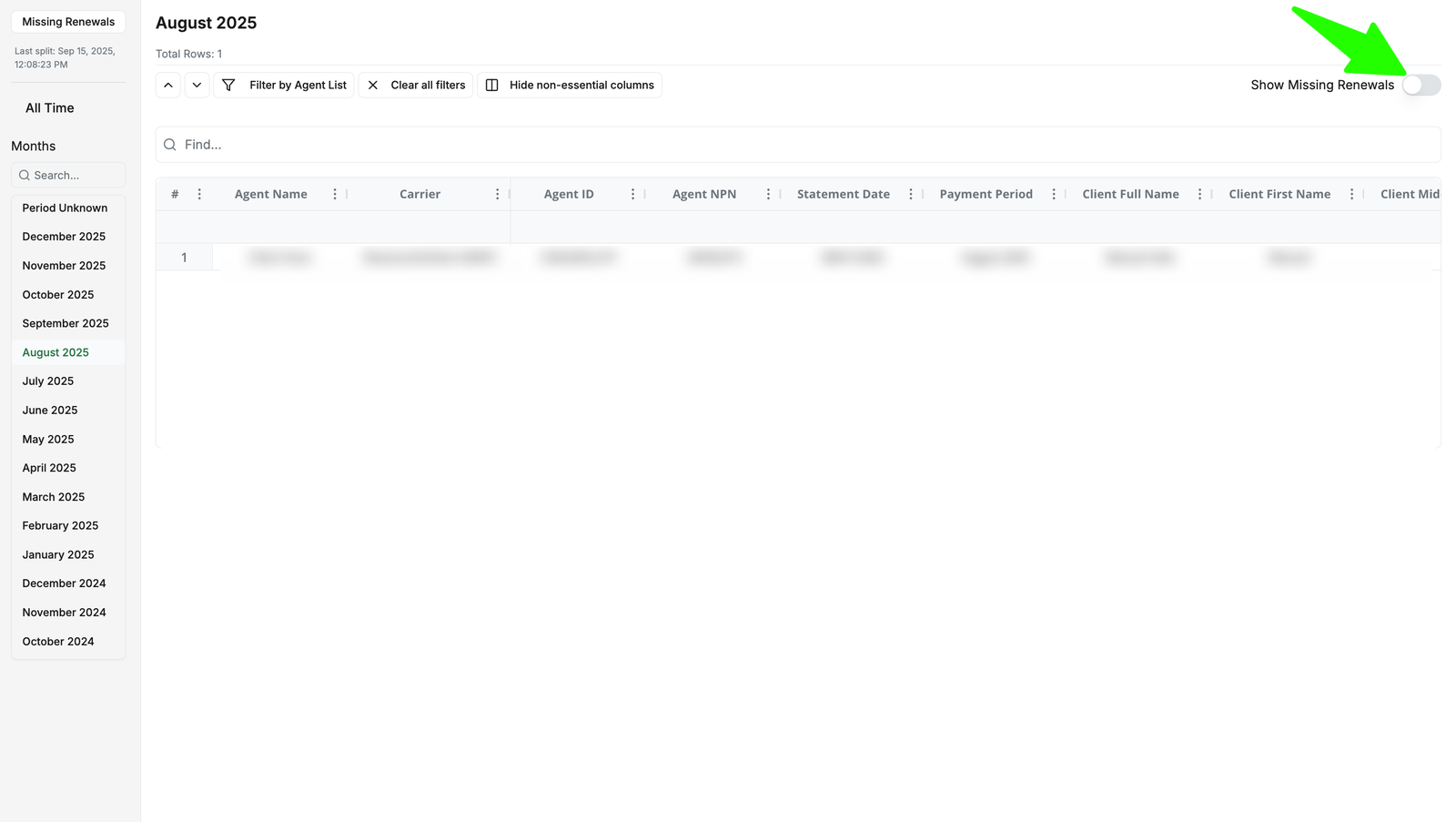
3. Missing Renewals
New business sales generate excitement and high initial commission advances, but the true enterprise value of an insurance agency lies in its book of renewals. Unfortunately, renewals are also where agencies lose the most money.
A client might continue paying their auto, home, or health premium every month, but the carrier system might accidentally drop the servicing agent code during an internal software migration. If an agent does not explicitly match every active policy against monthly incoming payments, renewals simply evaporate. Because individual renewal payments can be small (such as fifteen or thirty dollars a month per policy), missing them rarely triggers an alarm. Over hundreds of policyholders, however, uncollected renewals add up to thousands of dollars in annual losses.
4. Payment Reconciliation
Commission reconciliation is the disciplined practice of comparing what a carrier was supposed to pay against what was actually deposited into the bank account.
Most agents look at their bank balance, see a deposit from a carrier, match the deposit total to the bottom line of the carrier statement, and assume everything is correct. That is payment verification, not reconciliation.
True reconciliation requires evaluating expected commission versus received commission at the individual policy level. Did the carrier calculate the payout at the agreed fifteen percent contract tier, or did they drop the agent to a ten percent street rate? Did they deduct an unexpected chargeback for a client who never actually canceled? Without line-by-line reconciliation, agents routinely accept underpayments.
What Is Insurance Commission Tracking Software?
Insurance commission tracking software is a specialized financial platform engineered specifically to handle the complex, multi-tiered payout models of the insurance industry.
Unlike generic bookkeeping tools like QuickBooks or Xero, which only see bulk revenue and bulk expenses, commission software understands insurance hierarchies. It recognizes policy effective dates, premium modes, writing agent splits, agency overrides, chargebacks, and dynamic carrier commission schedules.
The software ingests raw carrier statements, extracts the policy numbers and payment data, normalizes the information into a single clean database, and automatically calculates agent splits based on predefined agency rules.
Benefits of Automated Commission Tracking
Upgrading from manual bookkeeping to modern insurance commission management transforms back-office agency operations.
1. Save Administrative Time
The most immediate return on investment comes from recovered hours. Instead of spending two full days each month manually parsing statements, importing data into spreadsheets, and creating individual producer reports, software automates the ingestion process. Carrier files are uploaded, mapped, and processed in minutes. Staff members can redirect their focus toward policy retention, marketing campaigns, and customer support.
2. Reduce Commission Errors
Automated systems run on clear mathematical rules rather than human data entry. The platform flags anomalies automatically:
- Policies listed with zero commission received
- Payout percentages that do not match current carrier contracts
- Sudden commission drops on active, paying policies
- Unexplained chargebacks on accounts outside the chargeback liability window
Catching these discrepancies right away allows agencies to file carrier disputes immediately rather than discovering lost funds years later during a tax audit.
3. Improve Revenue Visibility
When all commission data lives inside a centralized platform, agency leadership gains deep insight into business performance. Agency owners can generate instant reports showing:
- Which carriers deliver the highest average return per policy
- Which product lines drive stable monthly renewals versus volatile upfront cash
- The exact production totals and earnings for every sub-agent or broker
- Projected revenue pipelines for upcoming quarters
Clear visibility removes guesswork from agency budgeting, hiring decisions, and expansion plans.
4. Manage Multiple Carriers Easily
Automation breaks down carrier data silos. It does not matter whether an agency writes business through five carriers or fifty. The software standardizes every data point into a unified dashboard. You can search by client name, policy number, or writing agent and view a complete history of every payment received across all carriers over the entire lifetime of that policy.
Manual Spreadsheets vs Commission Tracking Software
Many agencies stick with spreadsheets because they feel familiar and cost nothing out of pocket. However, relying on spreadsheets carries steep hidden costs:
- Data Entry: Spreadsheets require constant manual input, copy-pasting, and formatting adjustments. Tracking software relies on automated file uploads, statement mapping, and direct imports.
- Accuracy: Spreadsheets have no native validation. One typing mistake or broken formula easily leads to incorrect sub-agent splits. Tracking software applies rules-based validation that flags mathematical errors before reports go out.
- Reconciliation: With spreadsheets, finding missing renewals requires visually scanning thousands of rows line by line. Commission software automatically compares policy records against carrier deposits to pinpoint missing payments instantly.
- Producer Split Calculations: Calculating tiered splits, sliding scales, and internal agency overrides in a spreadsheet requires writing fragile nested formulas. Commission software handles split calculations automatically according to individual agent contracts.
- Scalability: Spreadsheets begin to lag, corrupt, and break once an agency manages thousands of policies across multiple producers. Software platforms easily scale to handle hundreds of thousands of transactions without losing speed.
How Insurance Agencies Can Prevent Missing Commissions
To plug financial leaks and prevent revenue loss, agencies must establish a structured internal workflow.
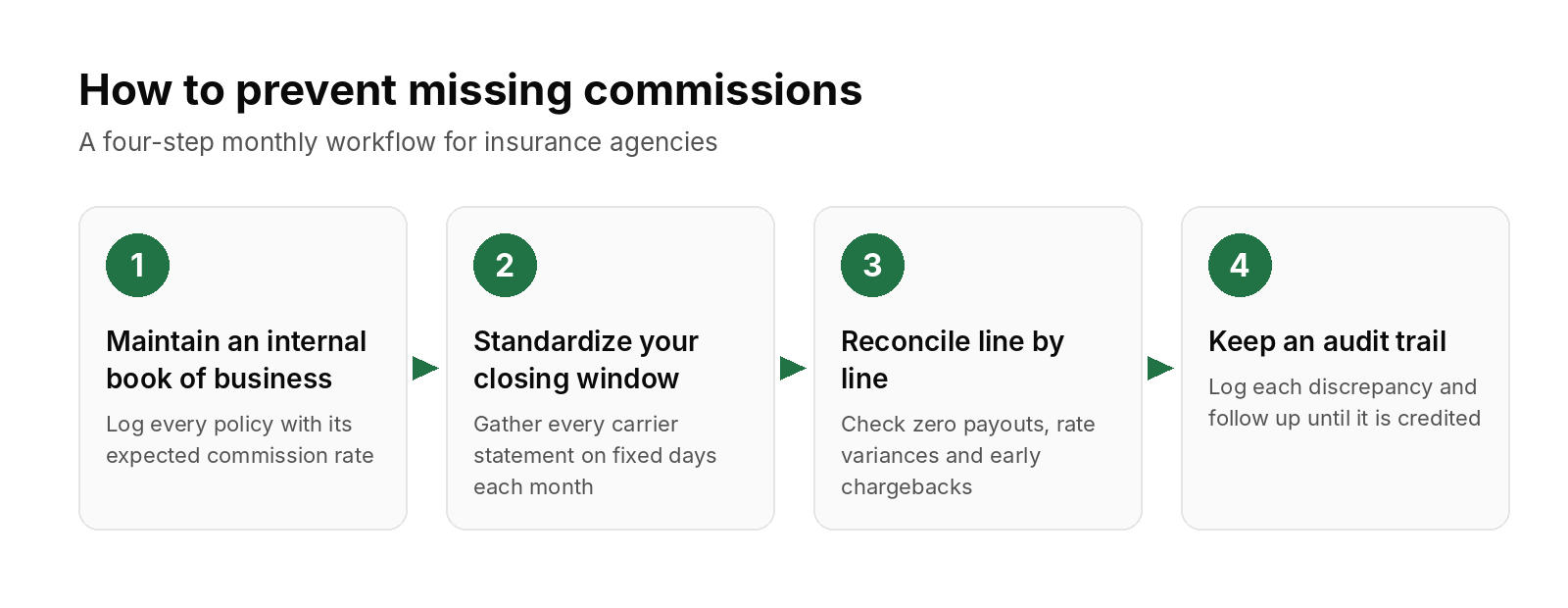
1. Maintain an Authoritative Internal Book of Business
Never rely on carrier portals to tell you what business you own. Every policy submitted by an agent must be logged inside your agency management system or client database immediately. This record must include the client name, application date, effective date, policy number, carrier, premium amount, and expected commission rate. This internal record serves as your master source of truth.
2. Standardize Your Monthly Closing Window
Do not process carrier statements sporadically throughout the month. Designate a specific recurring operational window, such as the fifth through the tenth of each month, to gather all statements from the previous cycle. Establishing a set routine ensures no carrier statement gets forgotten in an unopened email or left inside a portal.
3. Conduct Monthly Line-by-Line Reconciliations
Compare your master internal book of business directly against the incoming carrier data. Specifically check for:
- Active Policies with Zero Payout: The policy appears on your internal list as active, but the carrier statement contains no corresponding record.
- Rate Variances: The premium collected was one thousand dollars, but the commission deposited was based on an unauthorized lower rate.
- Premature Chargebacks: A carrier claws back an advance for a policy that they claim lapsed, even though the client can show proof of continuous payment.
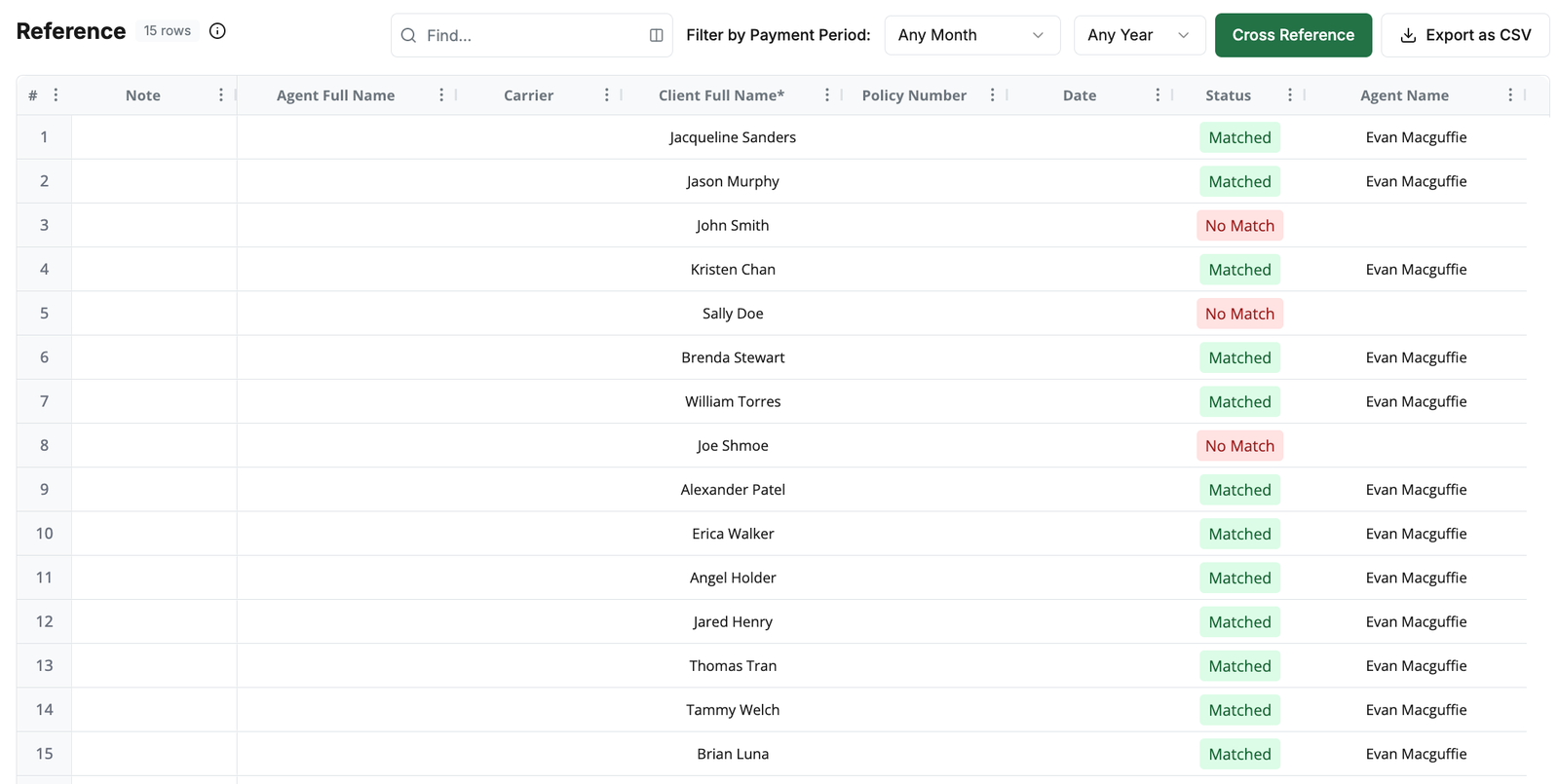
4. Create an Audit Trail for Discrepancies
When an underpayment or missing renewal is identified, log it in a dedicated dispute file. Include the carrier name, policy number, client details, payment variance, and the date your agency contacted the carrier representative. Follow up systematically until the carrier issues an adjustment credit on a subsequent statement.
Features to Look for in Commission Tracking Software
Selecting the right platform requires evaluating the specific operational needs of your agency. Look for these essential capabilities:
- Robust Carrier Statement Mapping: The software should read and parse varied file types, including CSV, Excel, tab-delimited text, and structured PDF formats, without forcing you to reformat the data manually first.
- Flexible Split and Hierarchy Management: Independent agencies often employ complex organizational structures. The platform must support direct agent splits, multi-tier agency overrides, house retainers, and graduated sliding-scale performance splits.
- Automated Reconciliation Engine: The system must feature a dedicated module that highlights underpayments, late fees, missing renewals, and discrepancies between expected terms and received checks.
- Sub-Agent Portal Access: High-producing agents want transparency. Software that provides read-only producer dashboards allows your agents to view their statements, production stats, and historical earnings, eliminating routine inquiries to your administrative staff.
- Medicare Compliance Support: For agencies active in the senior health market, Medicare commission tracking features are vital. The tool must handle CMS compensation caps, lifetime renewals, pro-rated monthly enrollments, and compliant reporting.
- Direct Integration Capabilities: The software should connect smoothly with your current agency management systems, customer relationship management platforms, and general ledger accounting software.
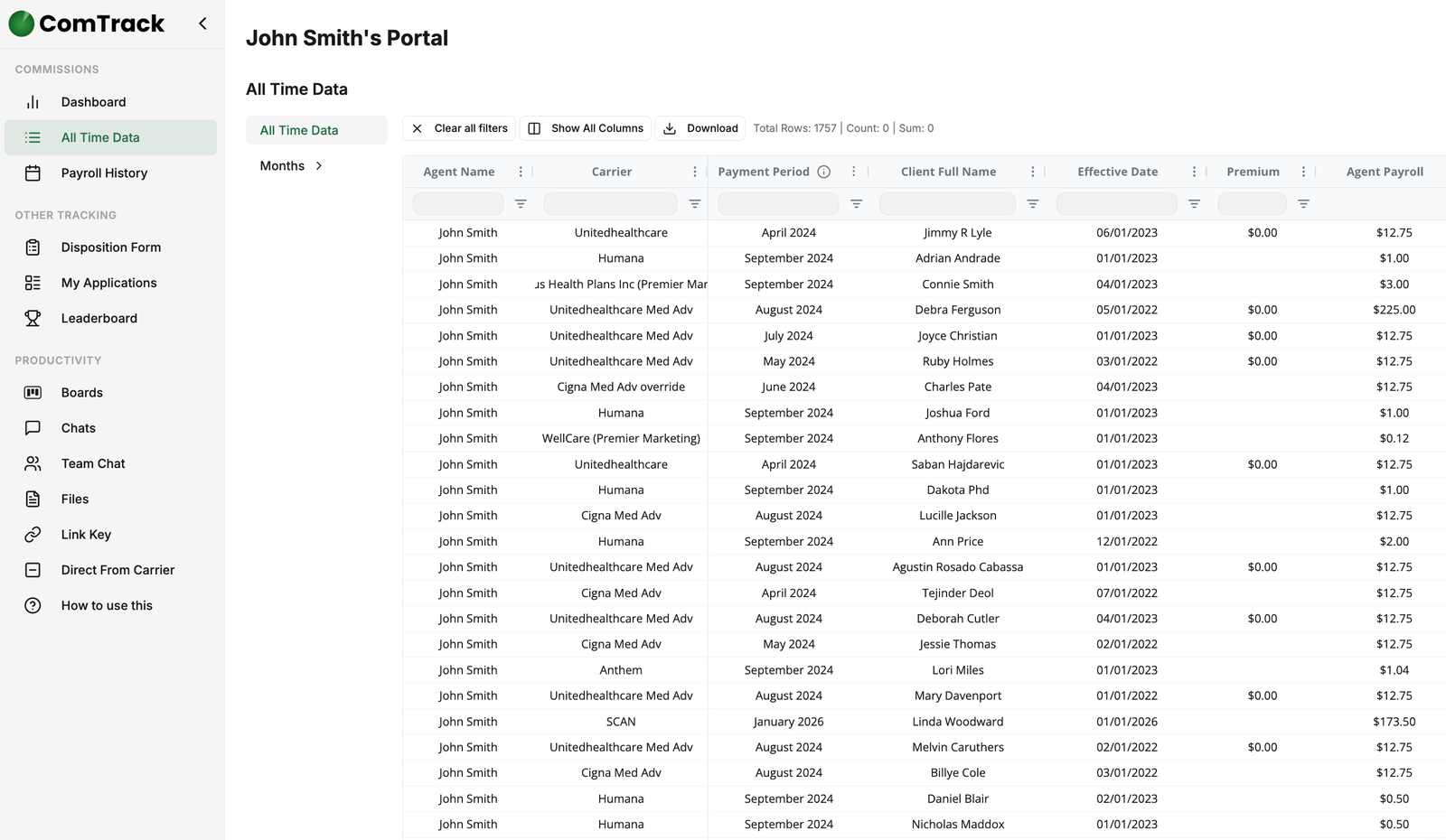
How ComTrack Helps Insurance Agents
For agencies ready to retire manual spreadsheets and take command of their revenue, dedicated solutions like ComTrack provide the specialized infrastructure needed to scale.
ComTrack is designed around the real-world workflow of the independent insurance agent. Instead of forcing agencies to adapt to rigid, generic accounting workflows, it addresses the core headaches of commission management:
- Rapid Carrier Import: ComTrack ingests raw carrier statements quickly, translating varied formats into a clean, unified view of revenue.
- Automated Split Execution: Agency administrators can configure custom producer contracts once. ComTrack applies those split rules across every imported statement, calculating precise producer payouts down to the penny.
- Deep Reconciliation Tools: The system actively monitors incoming payments against expected receivables, ensuring that missing renewals and unexpected carrier shortfalls are surfaced before they hurt the agency bottom line.
- Clear Producer Statements: Agencies can generate branded, professional payout summaries for sub-agents with a single click, fostering trust and improving agent retention.
By centralizing commission operations inside ComTrack, agencies protect their renewal books, save valuable administrative hours, and run their businesses with total financial clarity.
Frequently Asked Questions
1. What is insurance commission tracking?
Insurance commission tracking is the systematic process of recording, monitoring, and verifying payments received from insurance carriers for policies sold by an agency or its independent producers. It includes monitoring upfront advances, recurring monthly or annual renewals, agency overrides, and policy chargebacks to ensure all revenue is accounted for accurately.
2. Why do insurance agents need commission software?
Independent agents deal with multiple carrier compensation schedules, diverse statement formats, and varied producer split structures. Generic accounting software cannot track policy-level nuances or perform line-by-line carrier reconciliations. Commission software automates these calculations, catches carrier underpayments, and saves significant administrative time.
3. How do insurance agencies track commissions?
Agencies track commissions using either manual workflows or automated systems. In a manual workflow, staff members download statements from carrier portals, reformat the data, paste it into master spreadsheets, and write complex formulas to calculate producer splits. In an automated workflow, agencies use specialized software to import carrier files directly, map data fields, run split calculations, and reconcile deposits automatically.
4. What is commission reconciliation?
Commission reconciliation is the auditing process of comparing the exact commission amount an agency expected to receive on a policy against the amount the carrier actually remitted. This practice uncovers missing renewal payments, incorrect commission tiers, unauthorized chargebacks, and administrative errors made by insurance carriers.
5. Can commission software track multiple carriers?
Yes. Handling multiple carriers is the primary purpose of specialized commission platforms. The software accepts statements from dozens of different health, life, property, casualty, and Medicare carriers, standardizes the incoming policy metrics, and aggregates all revenue into a single, clean agency dashboard.